Structured cabling is the physical infrastructure that carries data, voice, and increasingly power across an office or building. It is invisible when it works, and extremely disruptive when it does not. Cabling that is installed to a recognised standard supports faster speeds, easier troubleshooting, cleaner expansion, and longer useful life. Cabling that is installed without reference to any standard creates problems that compound over time and often require full replacement to resolve.
For Nigerian organisations building or renovating office space, understanding what structured cabling standards require, and why they matter, is essential before any cable is pulled.
What structured cabling actually is
Structured cabling is not simply the act of running network cables. It is a system: a defined architecture that covers the horizontal cable runs from a central distribution point to each workstation outlet, the backbone connections between network rooms or floors, the termination hardware at each end, and the management and labelling that makes the whole system maintainable.
The international standards that govern structured cabling, primarily TIA-568 (developed in the United States and widely adopted globally) and ISO/IEC 11801, specify how this system should be designed and installed: maximum run lengths, bend radius limits, connector pin-out standards, testing requirements, and documentation. The NCC and Nigeria's building regulations do not currently mandate a specific cabling standard for commercial offices, but adherence to TIA-568 or ISO/IEC 11801 is the industry baseline for any professionally executed installation.
Cable category selection
The most common decision point in cabling design is cable category, the grade of cable that determines the maximum bandwidth and distance supported.
Cat 6 is currently the appropriate baseline for most new Nigerian office installations. It supports 1 Gigabit Ethernet to the full 100-metre horizontal run limit and 10 Gigabit Ethernet over shorter distances. It is cost-effective, widely available from reputable suppliers in Nigeria, and compatible with all current switching equipment.
Cat 6A is the correct choice for environments where 10 Gigabit Ethernet to the desktop is a current or planned requirement, typically data centres, server rooms, and technology-intensive workspaces. It is larger in diameter and more expensive, but it is the right specification for these contexts.
Cat 5e should not be specified for new installations in 2025. While it remains functional for 1 Gigabit Ethernet, it offers no headroom for future speed requirements and costs only marginally less than Cat 6. Specifying Cat 5e on a new installation is a false economy.
Fibre, specifically multimode fibre, is the correct medium for backbone runs between floors or buildings, runs over 100 metres, and connections to core switches. Single-mode fibre is appropriate for longer distances or campus environments with multiple buildings.
The structured cabling system architecture
A compliant structured cabling installation has a defined structure:
Telecommunications Room (TR) / Main Distribution Area (MDA)
The central point from which horizontal cabling radiates. In a single-floor office this is typically a wall-mounted rack or a small enclosed cabinet. In a multi-floor building, each floor may have its own TR connected to a Main Distribution Area by backbone cabling.
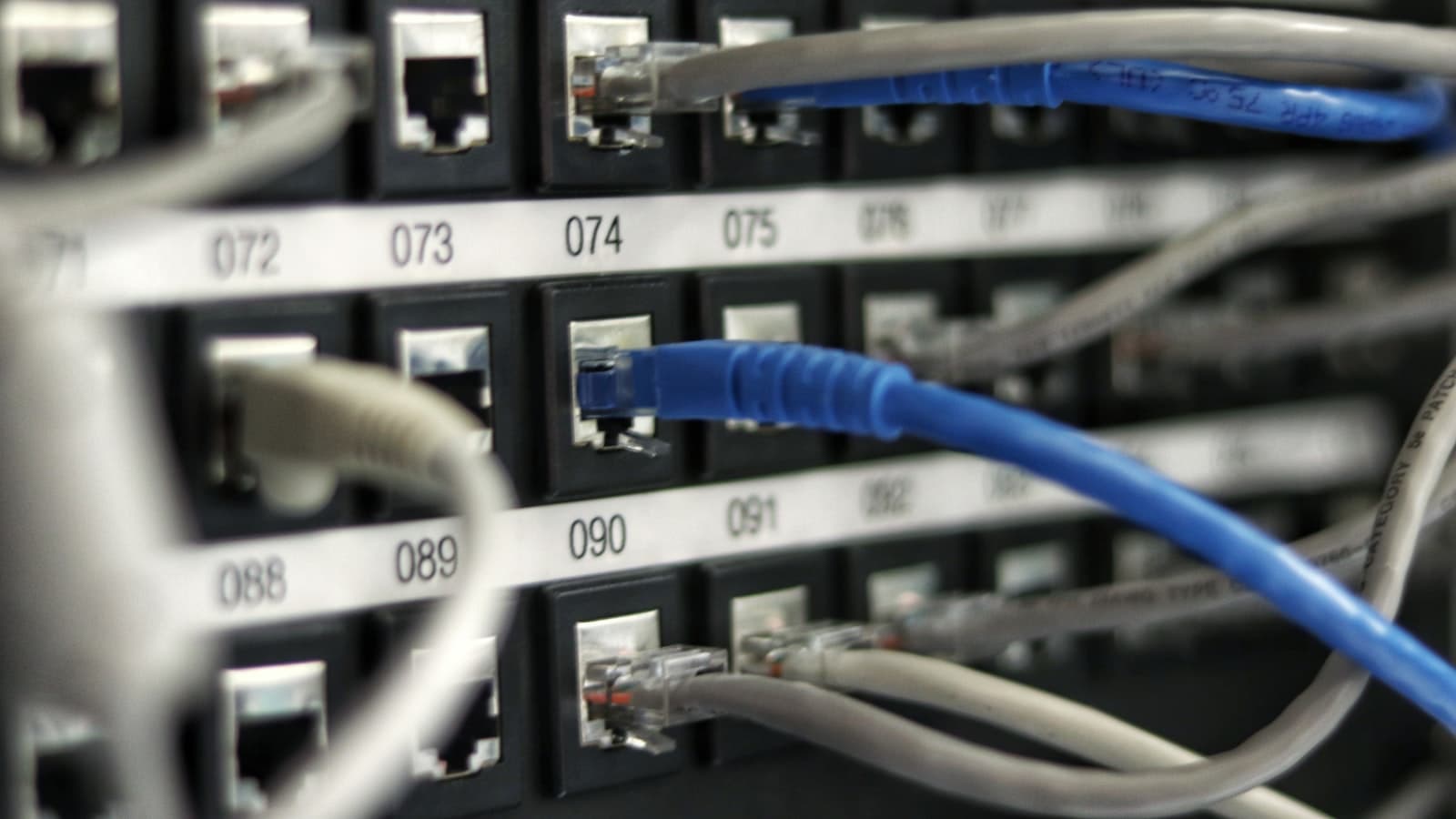
The TR contains: the horizontal patch panels that terminate all room cable runs; the active network equipment (switches); and the patch cables that connect panels to switches. Organisation within the TR matters, a well-organised rack with correct patch cable lengths and clear labelling is one that can be troubleshot quickly; a rat's nest of unlabelled cables is one that will cause problems every time something needs to change.
Horizontal cabling
The cable runs from the TR patch panel to each individual wall outlet. The maximum run length for copper horizontal cabling is 90 metres of permanent link, with an additional 10 metres allocated for patch leads at each end, 100 metres total channel length. Runs that exceed 90 metres of permanent link will fail at certification and will underperform in practice.
In Nigerian offices, routing horizontal cabling correctly is often complicated by the building construction: concrete walls, false ceilings that don't extend fully, and conduit that is absent or incorrectly sized. Planning cable routes before construction finishes, and installing conduit before walls are closed, is far cheaper than retrofitting routes through finished construction.
Work area outlets
Wall plates or floor boxes at each workstation, terminating in at least one RJ45 port (ideally two) per workspace. The connection between the wall outlet and the user's device is made with a patch lead, not a permanent cable run.
A common Nigerian installation error is running a single long cable from the switch directly to a device, bypassing the outlet entirely. This may work initially but creates a non-standard installation that is difficult to troubleshoot and impossible to certify.
Labelling and documentation
A structured cabling installation that is not labelled and documented is not a structured cabling installation, it is an undocumented cable run. Every outlet, every patch panel port, every cable run should be labelled with a consistent identifier, and a record of what connects where should be maintained. When the engineer who installed the system leaves, the documentation is what makes the system maintainable.
Cabling documentation costs very little to produce at installation time and can save days of troubleshooting work years later. Organisations that skip it always regret it.
Nigerian-specific design considerations
EMI and power interference
In environments with heavy electrical infrastructure, generator sets, large UPS units, air conditioning equipment, electromagnetic interference from power cables can affect data cable performance. The TIA-568 standard specifies minimum separation distances between data cabling and power cabling. In Nigerian office environments where generator sets and ATS panels are often located close to building IT infrastructure, maintaining these separations requires deliberate planning.
Ambient temperature and humidity
Cable runs through ceiling voids, wall spaces, and raised floors in Nigerian climates may experience higher temperatures and humidity than assumed in standard design. Cable jackets should be specified for the environment, LSZH (Low Smoke Zero Halogen) cable is appropriate for enclosed spaces, and outdoor-rated cable should be used for any external runs.
Conduit and protection
In Nigerian office construction, surface-mounted trunking or conduit is common where concealed installation is not possible. Surface trunking should be sized for the number of cables it carries, with headroom for future additions, and should be secured properly. Cable running loose along skirting boards or through unprotected penetrations is a failure in the making.
Testing and certification
A structured cabling installation should be tested and certified on completion. A cable certifier, a specialist instrument that measures cable performance against the relevant standard, produces a pass/fail result for each installed link. Any link that fails testing should be repaired or replaced before the installation is accepted.
Testing certificates provide documentation that the installation meets the standard it was designed to. For infrastructure solutions projects delivered to enterprise, banking, or government clients, certification is typically a project deliverable and a condition of acceptance.
Frequently asked questions
Does it matter if we use cables from different brands across the installation?
A structured cabling system is designed to work as an integrated whole, and manufacturers often certify their systems end-to-end, meaning that mixing components from different manufacturers may void the system warranty, even if each individual component is standard-compliant. This doesn't mean all components must come from one manufacturer, but it does mean that substituting patch panels, outlets, and patch leads from different brands without checking compatibility is a risk worth avoiding.
How many outlets do we need per workspace?
A minimum of two data outlets per workstation is the standard recommendation. This provides one connection for the computer and one for a phone or secondary device, without requiring a desktop switch. Open-plan offices should also factor in growth: outlets installed during construction cost a fraction of outlets added through finished walls.
What is the difference between tested and certified cabling?
A tested installation confirms that the cables are connected correctly and carry signal. A certified installation uses a calibrated instrument to verify that the cable plant meets the performance specifications of the relevant standard (Cat 6, Cat 6A, etc.) for bandwidth and noise characteristics. Certification is what you need if performance guarantees matter, which they do for any professional installation.
When should fibre be used instead of copper?
Fibre is appropriate for backbone runs between floors or buildings, any horizontal run exceeding 90 metres (where copper cannot be used at all), environments with extreme EMI, and connections requiring more than 10 Gigabit Ethernet throughput. For typical workstation connections within 90 metres, copper Cat 6 remains the cost-effective and technically appropriate choice.